
Tech Meets Haute Couture: The Digital Fashion Revolution
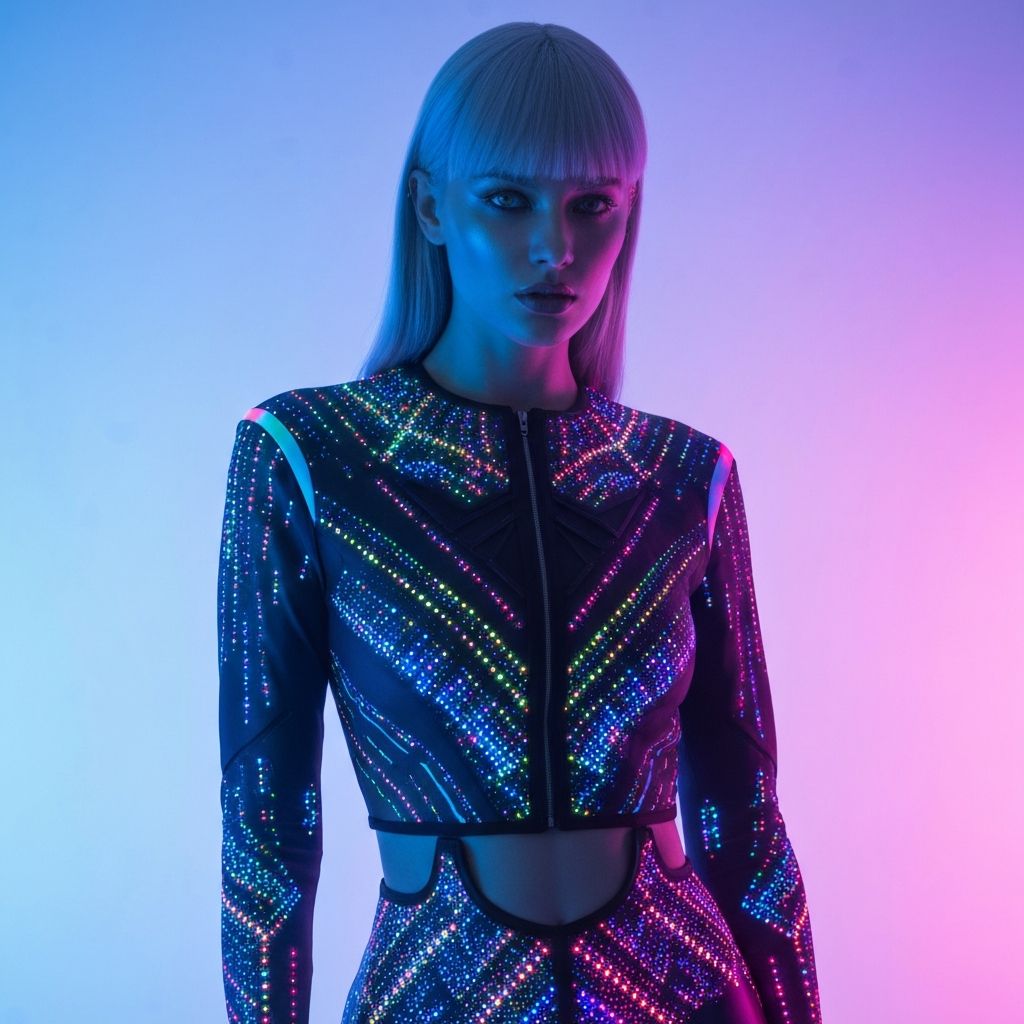
The marriage of technology and haute couture has produced offspring no one quite expected. Far from the cold, robotic aesthetic once associated with "tech fashion," today's innovations are enabling warmth, personality, and unprecedented creative expression.
AI as Creative Partner
Perhaps the most controversial development is the use of artificial intelligence in design. Rather than replacing designers, forward-thinking houses are using AI as a collaborative tool—generating thousands of variations that human designers then curate and refine.
Iris van Herpen, whose work has always straddled the line between fashion and technology, presented a collection where every print was generated through a collaboration between her team and custom AI models trained on natural phenomena. The results are impossible organic patterns that no human hand could create alone.
Smart Fabrics Go Mainstream
The promise of smart fabrics is finally being realized. Coperni's latest collection includes pieces with embedded flexible displays that can show different patterns based on the wearer's mood or the occasion—imagine a little black dress that can transform into a riot of color for evening.
More practically, temperature-regulating fabrics that warm or cool based on ambient conditions are becoming standard in luxury sportswear and are beginning to appear in everyday fashion.
The Virtual Wardrobe
Digital fashion has evolved far beyond gaming avatars. Luxury houses now offer exclusive digital-only pieces for virtual environments, and the secondary market for digital fashion is booming.
But the real revolution is in try-on technology. Augmented reality has become sophisticated enough that online shopping can now accurately represent how garments will look on individual bodies, dramatically reducing returns and their associated environmental impact.
The Human Core
Despite all this technology, the human element remains paramount. "Technology should be invisible in the final garment," insists designer Ying Gao, known for her responsive garments that move based on the observer's gaze. "It's a means to create emotion, not a replacement for it."
As we move deeper into 2026, the most successful fusion of tech and fashion will be those that enhance human connection and expression, rather than overshadowing it.